Emeritus Professor of Economics · Universidad Carlos III de Madrid

Luis C.
Corchón

I am an economic theorist working on contests, industrial organization, mechanism design, political economy and the economics of conflict.

Career
UC3M since 1997
Doctoral students
15 supervised
Books
4 major projects
Luis Corchón participating in an academic discussion
Madrid, SpainEconomic theory · Institutions · Competition

Profile

My career in economic theory, institution building and mentorship.

I hold doctorates in Economics from the London School of Economics and Universidad Complutense de Madrid, and an MSc in Econometrics and Mathematical Economics from the LSE.

I was Professor at the University of Alicante (1988–1996), a visiting professor at Pompeu Fabra University (1996–1997), and joined Universidad Carlos III de Madrid in 1997.

Video portrait · 2014

A conversation with Luis Corchón

Recorded at Universidad Carlos III de Madrid in June 2014, during the Workshop on Games in Markets, Organizations and Political Economy held in his honour, this interview offers a more personal introduction to Luis Corchón and his academic career.

Watch the interview
01 · Research

Research fields

My research spans five connected programmes, from foundational theory to applied institutional questions.

01Contests & conflictStrategic competition for prizes, power and resources — including contest design, conflict, sabotage and financial constraints.+

I study how contest rules shape effort, participation, exclusion and welfare, and how liquidity or information changes strategic behaviour.

01Contest foundations and designHow should contests be modelled and designed?+

Contest rules are not neutral. They determine how effort is translated into success, whether equilibrium exists and is unique, how much effort contestants expend and whether the resulting allocation is socially desirable. My work provides behavioural and institutional foundations for widely used contest success functions and characterizes robust designs, including contests with dominant strategies.

02Dynamic competitionHow do dynamics, financial constraints and entry reshape competition?+

When current competition changes future strength, contestants behave very differently from participants in a one-shot contest. Early victories can reinforce later advantages, while financially disadvantaged contestants may borrow and jeopardize their survival in order to remain competitive—the despair effect. Entry is also more delicate when contestants must choose among different arenas: equilibrium is guaranteed in some environments but may fail when participation is discrete and the arenas are interconnected.

03War and peaceWhen can conflict be avoided?+

Peace can often be sustained even when agreements are not enforceable. Transfers between rivals may prevent a costly war, although their direction and effectiveness depend on the distribution of resources, relative military strength and the cost of conflict. Initial ownership can enlarge the set of peaceful outcomes, whereas even a small amount of asymmetric information may destroy peace and trigger war.

04Destructive competitionWhen does competition become socially destructive?+

Competition may induce participants to weaken their rivals instead of improving their own performance. In cooperative production, merit-based rewards can generate more sabotage than egalitarian arrangements, and the absence of sabotage depends on the interaction between technology, relative productivity and the design of the sharing rule.

02Industrial organizationOligopoly, imperfect competition, entry, regulation and the measurement of welfare losses.+

My work connects equilibrium theory to market structure, innovation, financial constraints and public policy.

01Market structure, entry and collusionHow do entry, firm organization and financial constraints shape market structure?+

I study how firms shape market structure through entry, exit and internal organization. Allowing firms to create independent divisions can lead either to perfect competition or, when fixed costs matter, to a natural oligopoly. With free entry, familiar comparative-statics results may fail: an increase in demand can even reduce industry output, and observed profits or concentration can be misleading indicators of market power. Financial constraints add further instability by making the eventual exit of a firm unavoidable in some environments. Finally, repeated interaction can sustain an unusual form of collusion in which firms take turns holding monopoly power rather than coordinating their actions simultaneously.

02Market power and welfareHow can market power and its welfare costs be measured?+

I show that the welfare effects of market power cannot generally be inferred from concentration or price-cost margins alone. With asymmetric firms or fixed costs, welfare losses may remain very large even when several firms compete. Under product differentiation, standard market data may be insufficient unless additional information about demand elasticities is available. My work develops formulas and models that make these losses measurable while explaining why conventional assumptions may systematically understate them.

03Product differentiation and technologyHow do product differentiation, quality and technology affect competition?+

I study competition through dimensions other than prices and quantities. Inefficient location choices and incomplete market coverage can generate substantial welfare losses, sometimes larger than those produced by non-optimal quality. Technology transfer also depends critically on product differentiation and firm asymmetries: firms of different sizes may transfer technology fully, while technologically similar firms may have no incentive to do so.

04Regulation and policyHow should imperfectly competitive markets be regulated?+

I examine how regulation should respond to both market power and the regulator's limited information. Optimal merger policy is implementable only when private and social incentives are sufficiently aligned, as may occur when mergers generate verifiable cost savings. Price regulation depends on the interaction between demand, costs and uncertainty, while trade policy can produce counterintuitive welfare effects. Imperfect competition does not automatically transmit cost increases more strongly than perfect competition: precise conditions are required for this to occur.

03Mechanism designImplementation, strategy-proofness and the institutional conditions under which social objectives can be achieved.+

I study credible and robust implementation, renegotiation, public goods and environments in which the planner is also a strategic player.

01Credibility, information and renegotiationCan social objectives be implemented when the designer cannot fully commit?+

I study implementation when some of the assumptions behind standard mechanisms fail: the designer may be a strategic player, possess limited information or be unwilling to carry out the punishments prescribed outside equilibrium. I show when implementation remains possible under these constraints. Robust mechanisms may require remarkably little information, but credibility and renegotiation impose important limits. Paradoxically, giving the designer more information may sometimes reduce what can be credibly implemented.

02Market implementationCan decentralized market mechanisms implement efficient outcomes?+

I construct decentralized games that reproduce allocations normally associated with competitive or socially desirable outcomes. Simple market mechanisms can implement ratio equilibria for public goods and make Nash, strong and active Walrasian equilibria coincide, including in economies with indivisible goods. Mechanisms can also implement Pigouvian allocations in the presence of externalities. However, implementation becomes much more difficult when relevant states cannot be contracted upon or when trade takes place before prices reach equilibrium.

03Strategy-proofness and incentive compatibilityWhen is truthful behaviour compatible with efficiency?+

I investigate whether efficient mechanisms can induce agents to reveal their private information truthfully. For public and private goods, efficiency and individual rationality are generically incompatible with strategy-proofness, even when preferences are restricted to relatively small domains. These impossibility results identify when designers must abandon dominant-strategy truth telling and rely instead on equilibrium implementation.

04Applications and experimentsCan implementation solve concrete allocation problems—and does it work in practice?+

I apply implementation theory to scholarship assignment and the distribution of output from a commonly owned technology. Appropriately designed mechanisms can overcome conflicting individual interests and implement efficient allocations. Experimental evidence also shows that a canonical Nash mechanism selects the intended outcome in a large majority of cases, while simple fines can substantially improve its performance. Informal social restrictions—what a community considers a ‘decent’ proposal—may also shape the outcomes that can be implemented.

04Political economyPolitical organizations, governance, voting, meritocracy and institutional incentives.+

I apply game-theoretic tools to democratic organizations, political parties, rent seeking, redistribution and collective production.

01Institutions and unproductive behaviourCan political institutions always reduce unproductive behaviour?+

I study institutions in which individuals choose between productive activity, rent seeking and tax evasion. Institutional reform does not necessarily improve economic performance: parliamentary rule may generate more rent seeking than autocracy, even when no individual has an intrinsic preference for it. Tax compliance also depends on strategic interaction between the government and taxpayers, particularly when individuals can choose whether to enter the underground economy.

02Power and organizational dynamicsHow do democratic organizations evolve and distribute political power?+

I study how voting affects the composition and political control of organizations over time. An organization that formally rewards excellence may nevertheless experience cycles in the quality of its members and eventually become dominated by mediocre agents. In democratic organizations, forward-looking individuals may voluntarily relinquish power to another group. Highly productive members can also be exploited or excluded when their participation threatens the coalition currently in control—a phenomenon I call political unemployment.

03Meritocracy, efficiency and votingHow can cooperative organizations balance meritocracy, efficiency and democratic choice?+

I examine how collectively owned organizations choose reward systems and work incentives. Efficient and individually rational sharing rules need not be selected by majority voting, while fully efficient cooperation requires very particular institutional conditions. Meritocracy can increase effort and output, but excessive meritocracy may encourage socially excessive work or sabotage. In a dynamic economy, meritocracy promotes human-capital accumulation, yet only a particular degree of meritocracy achieves intergenerational efficiency.

04Distributive justiceHow can society reconcile conflicting ideas of distributive justice?+

Rather than assuming that there is a single universally accepted criterion of justice, I study societies in which individuals hold different views about fair outcomes. I represent these views through aspiration functions and develop procedures for aggregating them into a socially acceptable judgement. Many familiar concepts of distributive justice emerge as particular cases of this general approach.

05Aggregative gamesGames in which each player responds to an aggregate of the actions chosen by all participants.+

I develop comparative-statics and equilibrium tools with applications across economics, political science and engineering.

01The aggregative structureHow can complex strategic interactions be reduced to a manageable aggregate?+

I study games in which each player’s payoff depends on their own action and on an aggregate of the actions chosen by all participants. This structure makes it possible to analyse large and heterogeneous games without tracking every bilateral interaction. Aggregative games provide a common framework for models of oligopoly, public-good provision, contests, political competition and problems in engineering and other social sciences.

02Comparative statics and shocksHow do shocks and changes in the number of players affect equilibrium?+

I develop comparative-statics tools for studying how equilibrium actions and payoffs respond to changes in the number of players or in the parameters of their payoff functions. Under strong concavity and strategic substitutability, general aggregative games inherit and extend many familiar results from the Cournot model. I also show that differentiable comparative statics can remain valid when payoff functions contain kinks: equilibrium does not occur at the points where profits are non-differentiable.

03Stability and adjustment dynamicsDo simple adjustment processes converge to equilibrium?+

I examine whether players reach equilibrium when they repeatedly adjust their actions through best replies or gradient dynamics. With two players and one-dimensional strategies, a broad class of adjustment processes converges. With three players, however, even strong restrictions on demand and costs do not guarantee stability: best-reply and gradient dynamics can display virtually unrestricted—and even chaotic—behaviour.

02 · Current work

Questions I am working on now

My current projects examine how strategic competition shapes firms’ survival, forecasts and political outcomes.

Research stream 01

Contests

01

Competition, predation and financial constraints

Carmen Beviá, Petros Sekeris and I study procurement and other dynamic contests in which firms must invest to remain active. We show that liquidity constraints can turn early competition into predation: equilibrium may involve deliberately unpredictable investment, strategic withdrawal and entry prevention.

The Sting of the Winner: Predation and Competition in Dynamic Contests
02

Strategic forecasting

Carmen Beviá and I study forecasting competitions in which the probability of an event is known but rewards depend on relative performance. Competition can distort forecasts away from true probabilities—and predicting an unlikely event may be exceptionally profitable.

Working paper forthcoming
Research stream 02

Political economy

03

Implementation through political parties

Guadalupe Correa-Lopera and I identify when competition among two or more political parties implements the socially optimal policy—and when convergence occurs at a non-optimal platform. With more than two parties, the search for political representation can obstruct convergence. The analysis also reveals a counterintuitive upside to political opportunism: office-motivated parties may adapt more readily to changing social preferences.

Forthcoming in Games and Economic Behavior
Implementation via Political Parties
04

The electoral cost of infeasible promises

Guadalupe Correa-Lopera, Bernardo Moreno and I study repeated elections in which parties can offer attractive but unfeasible programmes. A lie may secure an immediate electoral victory, but once voters discover its infeasibility it creates a hostile environment and punishment in future elections. The project isolates the dynamic trade-off between short-run advantage and long-run credibility.

To Lie or Not to Lie: This Is the Question

03 · Publications

Publications

Here is my complete list of published articles, surveys and book chapters, ordered from most recent to earliest.

2026Collusion When Players Take Turnswith Guadalupe Correa-Lopera and Bernardo MorenoEconomics Letters 263, 1129182025Entry across Markets and Contests and Some Related Problemswith Ramón J. TorregrosaSocial Choice and Welfare 65(3), 645–6542024Folk Theorem under Bankruptcywith Carmen Beviá and Yosuke YasudaJournal of Mathematical Economics 1122022Contests with Dominant Strategieswith Carmen BeviáEconomic Theory 74(4)2022Properties of Contestswith Marco SerenaJournal of Dynamics and Games 9(2)2022Two Extensions of Consumer Surpluswith Ramón J. TorregrosaSERIEs 13(3), 557–5792021Aggregative GamesSERIEs 12(1)2020Cournot Equilibrium Revisitedwith Ramón J. TorregrosaMathematical Social Sciences 106, 1–102020Oligopolistic Equilibrium and Financial Constraintswith Carmen Beviá and Yosuke YasudaRAND Journal of Economics 51(1), 279–3002020Disequilibrium Trade in a Large Market for an Indivisible Goodwith José Rueda-LlanoB.E. Journal of Theoretical Economics 20(2), 1–16
2018Meritocracy, Efficiency, Incentives and Voting in Cooperative Production: A Surveywith Carmen BeviáAnnals of Public and Cooperative Economics 89(1), 87–107
2018Contest Theorywith Marco SerenaHandbook of Game Theory and Industrial Organization, Vol. II, 125–1462018Technology Transfer: Barriers and Opportunitieswith Clara Eugenia GarcíaJournal of Dynamics and Games 5(4), 343–3552018Imperfectly Competitive Markets, Trade Unions and InflationJournal of Dynamics and Games 5(3), 189–201
2017Growth in Illyria: The Role of Meritocracy in the Accumulation of Human Capitalwith Carmen BeviáMathematical Social Sciences 90, 182–190
2017Relinquishing Power, Exploitation and Political Unemployment in Democratic Organizationswith Carmen Beviá and Antonio Romero-MedinaSocial Choice and Welfare 49, 735–753
2017Trade and Growth: A Simple Model with Not-So-Simple ImplicationsJournal of Dynamics and Games 4(2), 175–190
2016Dynamic Contests with Bankruptcy: The Despair Effectwith Carmen BeviáB.E. Journal of Theoretical Economics 16(1), 217–241
2016A Malthus–Swan–Solow Model of Economic GrowthJournal of Dynamics and Games 3(3), 225–230
2016Interpreting Markups in Spanish Manufacturing: The Exponential Modelwith Lourdes MorenoEquilibrium Theory for Cournot Oligopolies and Related Games, Springer, 119–131
2015Centralized vs. Decentralized Contestswith Carmen BeviáEconomics Letters 137, 32–35
2015Relative Difference Contest Success Functionwith Carmen BeviáTheory and Decision 78, 377–398
2013The Welfare Effects of Location and Quality in Oligopolywith Galina ZudenkovaB.E. Journal of Economic Analysis & Policy 13(2), 1143–11782013Endogenous Strength in Conflictswith Carmen BeviáInternational Journal of Industrial Organization 31(3)
2013Give Peace a Chance: The Effect of Ownership and Asymmetric Information on Peacewith Anıl YıldızparlakJournal of Economic Behavior & Organization 92, 116–126
2012Price Regulation in Oligopolistic Marketswith Félix MarcosISRN Economics, Article 509165
2011Welfare Maximizing Contest Success Functions When the Planner Cannot Commitwith Matthias DahmJournal of Mathematical Economics 47(3), 309–317
2011Implementation with State-Dependent Feasible Sets and Preferences: A Renegotiation Approachwith Matteo TriossiSocial Choice and Welfare 36(2), 179–198
2010The Keynesian Multiplier and the Pigou Effect under Substitution between Private and Public ConsumptionEconomics Bulletin 30(1), 829–836
2010Peace Agreements without Commitmentwith Carmen BeviáGames and Economic Behavior 68, 469–487
2010Foundations for Contest Success Functionswith Matthias DahmEconomic Theory 43(1), 81–982009Computing Welfare Losses from Data under Imperfect Competition with Heterogeneous Goodswith Galina ZudenkovaInternational Journal of Industrial Organization 27, 646–654
2009Cooperative Production and Efficiencywith Carmen BeviáMathematical Social Sciences 57(2), 143–154
2009The Theory of Implementation: What Did We Learn?Encyclopedia of Complexity and Systems Science, Springer
2009War or Peacewith Carmen BeviáThe Political Economy of Democracy, Fundación BBVA, 318–334
2008Differentiable Strategy-Proof Mechanisms for Private and Public Goods in Domains That Are Not Necessarily Large or Quasi-Linearwith José Rueda-LlanoReview of Economic Design 12(4), 279–291
2008Welfare Losses under Cournot CompetitionInternational Journal of Industrial Organization 26(5)
2008Forms of Governance and the Size of Rent-SeekingSocial Choice and Welfare 30(2), 197–210
2007The Theory of Contests: A SurveyReview of Economic Design 11(2), 69–100
2007Instability and Trade in Currency Areaswith Alberto Alonso and Vanesa GuzmánEconomics Letters 94(1), 71–75
2006Credible Implementationwith Bhaskar Chakravorty and Simon WilkieGames and Economic Behavior 57(1), 18–36
2006Rational Sabotage in Cooperative Production with Heterogeneous Agentswith Carmen BeviáB.E. Journal of Theoretical Economics 6(1), 1–29
2005Monk Business: An Example in the Dynamics of OrganizationsSocial Choice and Welfare 24(3), 543–556
2004To Merge or Not to Merge: That Is the Questionwith Ramón Faulí-OllerReview of Economic Design 9(1), 11–30
2004A Decent Proposalwith Carmen HerreroSpanish Economic Review 6(2), 107–125
2003The Long-Run Keynesian MultiplierEconomics Bulletin 5(16), 1–11
2003An Experiment on Nash Implementationwith Antonio Cabrales and Gary CharnessJournal of Economic Behavior & Organization 51(2)
2003Double Implementation of the Walrasian Correspondence by Market Gameswith Carmen Beviá and Simon WilkieReview of Economic Design 7(4), 429–442
2002Comparative Statics in Cournot Free-Entry Equilibriumwith Isabel FraderaMathematical Social Sciences 44(2), 155–168
2002Existence and Nash Implementation of Efficient Sharing Rules for a Commonly Owned Technologywith M. Socorro PuySocial Choice and Welfare 19(2), 369–379
2002The Scholarship Assignment Problemwith Pablo Amorós and Bernardo MorenoGames and Economic Behavior 38(1), 1–18
2001A Proposal to Unify Some Concepts in the Theory of Fairnesswith Iñigo Iturbe-OrmaetxeJournal of Economic Theory 101(2), 540–571
2001Differentiable Comparative Statics with Payoff Functions Not Differentiable EverywhereEconomics Letters 72(3), 397–401
2001Second-Best Trade Policies in Cournot Oligopolywith Miguel González-MaestreSpanish Economic Review 3(2), 81–96
2000The Allocative Effects of Rent-SeekingJournal of Public Economic Theory 2(4), 483–491
2000Contingent Commodities and Implementationwith Subir Chattopadhyay and Jörg NaeveEconomics Letters 68(3), 293–298
2000On the Competitive Effects of Divisionalizationwith Miguel González-MaestreMathematical Social Sciences 39(1), 71–80
1999Pigouvian Taxes: A Strategic Approachwith José Alcalde and Bernardo MorenoJournal of Public Economic Theory 1(2), 271–281
1998Individual Rationality and Voting in Cooperative Productionwith M. Socorro PuyEconomics Letters 59, 83–90
1997The Theory of Implementation When the Planner Is a Playerwith Sandeep Baliga and Tomas SjöströmJournal of Economic Theory 77(1), 15–33
1996Double Implementation of the Ratio Correspondence by a Market Mechanismwith Simon WilkieReview of Economic Design 2, 325–337
1996On the Stability of Best Reply and Gradient Systems with Applications to Imperfectly Competitive Modelswith Andreu Mas-ColellEconomics Letters 51, 59–65
1995Robust Implementation under Alternative Information Structureswith Ignacio Ortuño-OrtínReview of Economic Design 1, 159–171
1995On the Generic Impossibility of Truthful Behavior: A Simple Approachwith Carmen BeviáEconomic Theory 6, 365–371
1994Fixed Prices and Quality SignalsMathematical Social Sciences 27, 49–58
1994Comparative Statics for Aggregative Games: The Strong Concavity CaseMathematical Social Sciences 28, 151–165
1992Tax Evasion and the Underground EconomyEuropean Journal of Political Economy 8, 445–454
1991Oligopolistic Competition among GroupsEconomics Letters 36, 1–3
1991Monopolistic Competition: Equilibrium and OptimalityInternational Journal of Industrial Organization 9(3), 441–452
1990Unemployment and Rationalitywith José A. TrujilloScandinavian Journal of Economics 92(1), 99–107
1989An Elementary Proof of the Existence of a Competitive Equilibrium in a Special Casewith Rosa BarbollaQuarterly Journal of Economics 104(2), 385–389
1988Entry, Stackelberg Equilibrium and Reasonable Conjectureswith Félix MarcosInternational Journal of Industrial Organization 6(4), 509–515
1988Cost Prices with Variable ReturnsMetroeconomica, 93–99

04 · Books

Books & edited volumes

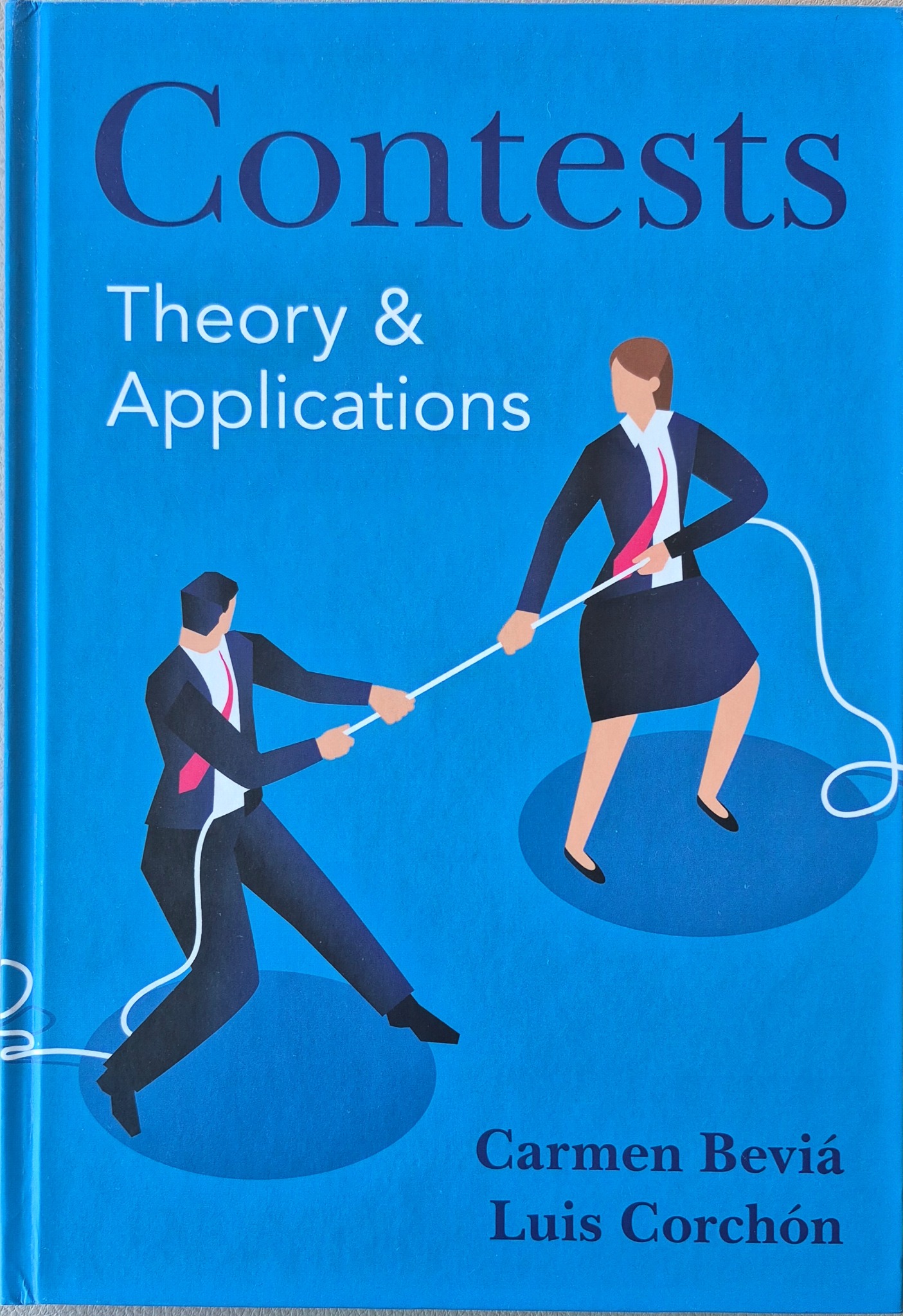
These four book projects trace my research from implementation and imperfect competition to modern contest theory.

Cover of Handbook of Game Theory and Industrial Organization
2018 · Edward Elgar

Handbook of Game Theory and Industrial Organization

edited with Marco A. Marini

Edited with Marco A. Marini, these two complementary volumes present the principal game-theoretic tools used in industrial organization and develop their applications to classical and emerging IO topics.

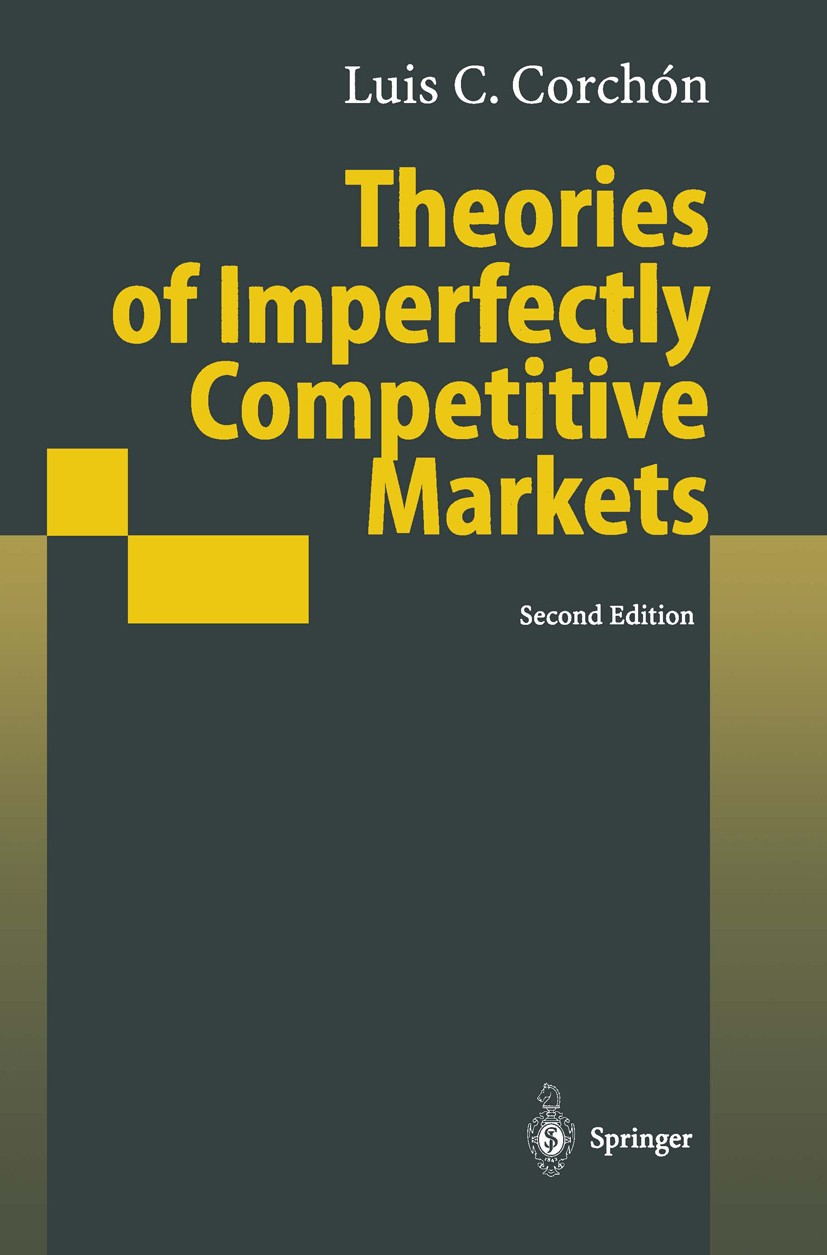
Cover of Theories of Imperfectly Competitive Markets
2000 · Springer

Theories of Imperfectly Competitive Markets

second edition · first edition 1996

In this book, I develop a game-theoretic introduction to markets in which firms interact strategically, covering equilibrium, comparative statics and welfare analysis through more than 200 exercises.

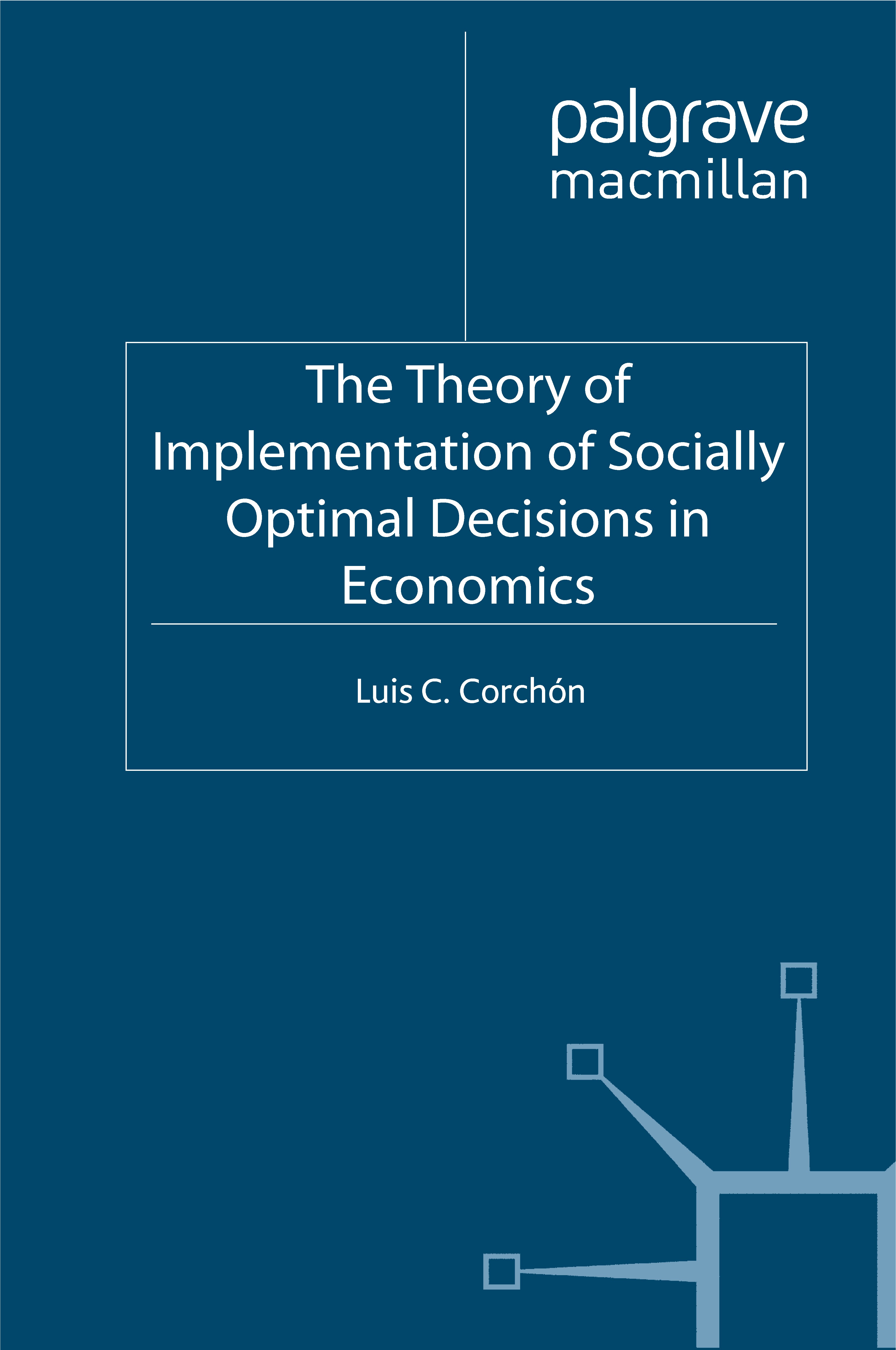
Cover of The Theory of Implementation of Socially Optimal Decisions in Economics
1996 · Palgrave Macmillan

The Theory of Implementation of Socially Optimal Decisions in Economics

monograph

In this monograph, I examine how institutions can reconcile socially desirable goals with private incentives under dominant strategies, Nash equilibrium and incomplete information.

05 · PhD students

My doctoral students

I have supervised fifteen completed doctoral dissertations across four decades. My former students now work at universities in Spain, Germany, Italy, the United Kingdom and Australia.

Placements reflect publicly available information reviewed in August 2026. I will add co-supervision details and distinctions in the next content revision.

06 · Teaching

Teaching & supervision

07 · Outreach

Economics beyond academia

I write for wider audiences about economics, mathematics, education and academic life. These contributions are in Spanish; their original titles have been retained.

Complete archive

Browse the collection by theme. Entries are ordered from the most recent to the earliest.

01

Economics, institutions & society

Essays on markets, welfare, meritocracy, conflict and the role of economics in public debate.

2025ArticleESDas Kapital II. Más allá del mercadoA discussion of what lies beyond market exchange: power, coalitions, conflict, resource ownership and contests.Nada es Gratis2024ArticleESEconomía y medicinaWhat economics can learn from medicine about diagnosis, evidence and policy prescriptions.Nada es Gratis2023ArticleESEl economista no da mandobles. Dispara cañonesA reflection on the analytical tools economists use to understand complex social problems.Nada es Gratis2022ArticleESDas Kapital (1867), 155 años después: I. Valor, propiedad y explotaciónA contemporary reading of Marx on value, ownership and exploitation.Nada es Gratis2022ArticleESEficiencia y equidad en las políticas económicasWhy sound economic policy must confront both efficiency and distribution.Nada es Gratis2021ArticleESPostscript a ‘János Kornai (1928–2021) y la crítica a la economía neoclásica’Further thoughts on experimentation, replication and informed criticism in economics.Nada es Gratis2021ArticleESJános Kornai (1928–2021) y la crítica a la economía neoclásicaAn assessment of Kornai’s work and his critique of neoclassical economics.Nada es Gratis2021ArticleESBienestar social y mercado (II)The second part of an exploration of competition, market power and social welfare.Nada es Gratis2021ArticleESBienestar social y mercado (I)An introduction to when markets promote welfare—and when they may fail.Nada es Gratis2021ArticleESLa meritocracia: a favorThe case for meritocratic selection, its limits and the role of affirmative action.Nada es Gratis2021ArticleESLa meritocracia: en contraA critical look at meritocracy, opportunity and the sources of individual achievement.Nada es Gratis2021ArticleESLas reformas…, pero ¿qué reformas?Why calls for reform require clear objectives, evidence and institutional detail.Nada es Gratis2021ArticleESAlgunas reflexiones sobre ‘The Weirdest People in the World’A critical discussion of Joseph Henrich’s account of culture, institutions and prosperity.Nada es Gratis2021ArticleESQué maximiza el homo economicus (III)The concluding part of a series on preferences, incentives and economic behaviour.Nada es Gratis2021ArticleESQué maximiza el homo economicus (II)The second essay in a series reconsidering what economic agents seek to maximize.Nada es Gratis2021ArticleESQué maximiza el homo economicus (I)The opening essay in a series on motivation and the economic model of choice.Nada es Gratis2019ArticleESLas contiendas en la economíaAn accessible introduction to contests as a way of allocating prizes, power and resources.Nada es Gratis
02

Mathematics & economic thought

How mathematical language, models and quantitative methods transformed modern economics.

03

University, education & academic life

Writing on universities, doctoral training, educational systems and the culture of academic work.

2025ArticleES¿Cómo elegir un máster?Practical guidance on choosing a master’s degree: academic quality, accreditation, faculty, effort and personal fit.Universidad, sí2024ArticleES¿Qué es la academia?What defines academic life and why research is inseparable from university teaching.Nada es Gratis2024Book forewordESPrólogo a Economía de la educaciónAn introduction to a collective volume on the economics of education.Fundación Ramón Areces2023ArticleESLa universidad no debe ser una fábrica de empleo presenteWhy universities should prepare students for changing futures, not only current vacancies.Universidad, sí2023ArticleESLa universidad no es un genéricoWhy universities differ profoundly in research, teaching and academic standards.Nada es Gratis2022ArticleESEl estado del sistema educativo españolA diagnosis of the strengths and weaknesses of Spain’s education system.Nada es Gratis2022ArticleESEspaña, Japón, Rusia y la educación. Apuntes para una historiaA comparative historical reflection on education and national development.Nada es Gratis2022ArticleESLa excelencia en el deporte y en la educaciónWhat education can learn from the identification and cultivation of sporting excellence.Universidad, sí2022Book chapterESAlgunas reflexiones sobre el presente y el futuro de la enseñanza en EspañaReflections on educational performance and the future of teaching in Spain.Fundación Ramón Areces2022ArticleESAlgunas reflexiones desde la experiencia para doctorandos y jóvenes profesionales en la academiaPractical advice for doctoral students and young scholars beginning an academic career.Nada es Gratis2021ArticleESEspecializarse o no especializarse: esa es la cuestiónA discussion of broad training, early specialization and the development of exceptional talent.Nada es Gratis2021ArticleESLas tribulaciones de un profe en un buen departamentoAn inside view of recruitment, evaluation and professional life in a strong economics department.Nada es Gratis2020ArticleESCómo funciona un departamento moderno de economíaHow research, hiring, seminars and teaching fit together in a modern economics department.Nada es Gratis2020ArticleESBreve e incompleta historia de la educación europea desde el siglo XVIIIA concise history of the institutions that shaped European mass education.Nada es Gratis

08 · Leadership

Institution building & service

2004–2007

Chair, Department of Economics

I chaired the Department of Economics at Universidad Carlos III de Madrid.

Editorial service

Editorial boards

  • Revista Española de Economía1993–1997
  • Journal of Public Economic Theory1997–2016
  • Review of Economic Design2001–2024
  • Journal of Dynamics and Games2015–present
  • Mathematical Social Sciences2020–present
Public service

Research evaluation

I have served as a member and chair of Spain’s national commission for the evaluation of academic research in economics.